When Should Your Nonprofit Start Planning Its Next Video?
Most nonprofit video projects start later than they should. Here's a realistic timeline, and why planning now means you're ready to shoot in the new year.
Every year as the end of the calendar nears, we tend to see the same thing happen.
It's a busy time of year for nonprofits. Development teams are deep in year-end giving season. Signature fundraising moments on the calendar: Giving Tuesday, end-of-year appeals, donor thank-yous, the last fall events.
Understandably, planning your video for next spring's gala feels like a problem for another day, so it gets pushed to "after the holidays."
We all know what happens next. The holidays hit! January brings strategic planning, budget conversations and the first board meeting of the year. By the time you circle back to planning for your gala video, it could be late January or early February. At that point, the big night may only be a couple of months away.
This certainly isn't impossible. We've produced great videos with our partners that we're incredibly proud of on a tighter timeline. But, it certainly can present some real challenges and may not leave you in the best position for success.
Consider the Timeline
Here's what a realistic timeline looks like for a single video, like the centerpiece film for your gala:
Week 1, kickoff and discovery: We align on your goals, your audience and what success looks like.
Weeks 2 to 4, pre-production: Scripting, storyboarding, interview planning and scheduling the shoot.
Week 5, production: The shoot itself.
Weeks 6 to 8, post-production: Editing, sound, color and two rounds of revisions with your team.
That's two months, at least, for one video. That's a tight timeline, even if everything goes according to plan.
A bigger engagement almost certainly would take longer. If you're planning a series of videos around a campaign, or a full year of donor storytelling, we build in more pre-production time because we're planning for more stories and more assets. Post-production usually doesn't end with the first delivery, either. Videos roll out in phases, sometimes for months after the first one goes live.
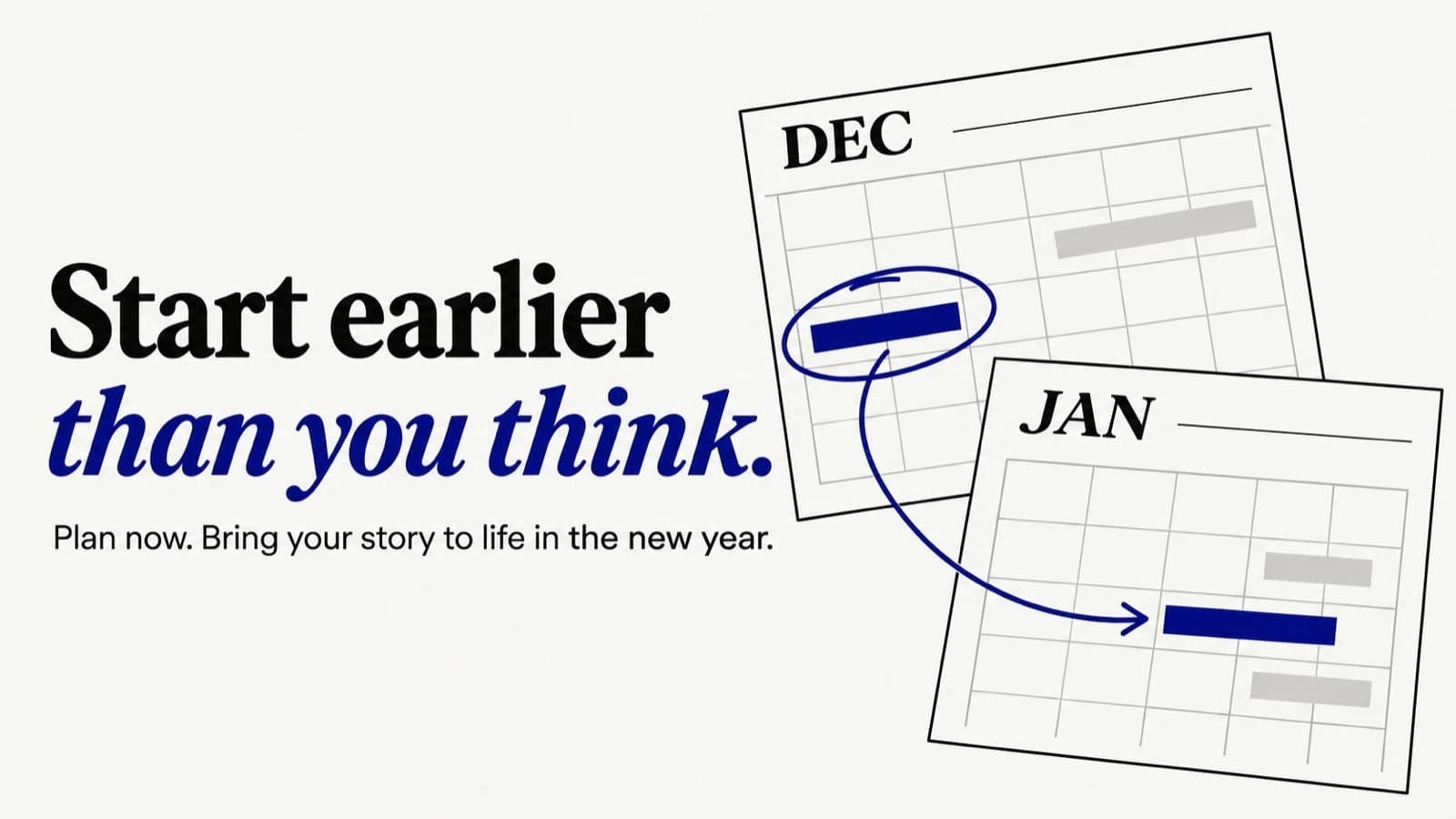
Let's say your gala is in April and you want content to support the event, both before and after. If the project kicks off the first week of February, you're shooting in March and delivering at the end of the month. That leaves almost no cushion before the big night, and very little time for a teaser to drive ticket sales, a sponsor preview or social cutdowns to keep the story going after the event.
If you launch your project in early December instead, your gala video is done by early February. That's two months to spare before the big night, with time to share it with your board, preview it for top donors and plan how it lives on after the gala.
Subject availability is something to consider as well. You want to tell your strongest story and you want to make sure the people you hope to feature are available to shoot.
Plan in December, Shoot Early in the New Year
This is why we recommend finalizing your content plan for 2027 before the end of the year. The more time you allocate to pre-production and planning, the better your end result. Most of that work takes time, but it doesn't take a lot of work from your team. It's our job to do the heavy lifting, while you focus on other responsibilities.
There are a number of considerations during pre-production. The right production partner will help you find the right person to feature, get their permission, line up schedules with a program director, an alum or a board chair. We may need to ensure access to a school, a clinic or a job site. Make sure we have sign-off from leadership. None of that needs your whole team's attention. It just needs time on the calendar.
We can get more of that done in December than you'd think. Our kickoff call, a few emails and a couple of key decisions, and the plan is in place before everyone heads out for the holidays. Come January, we're not starting a project. We're ready to shoot.
There's another reason we've found December works well. The stories are fresh. You just came out of fall events and year-end appeals, and you have a good sense of what connected with donors this year and what didn't. That's exactly the kind of insight you want going into planning. We're able to use that information and build out our storytelling system.
Our recommended timeline isn't only a December thing. Whatever's on your calendar, whether it's a spring gala, a giving day or a fall campaign, count back two months for one video, longer for a storytelling system, and add a little cushion for safety. That's when we recommend starting.
What an Early Start Actually Buys You
We see the difference in our own work all the time.
A great example of this is our annual partnership with ATLAS Fellows. Their gala is in late spring, but we start planning together in early fall. That lead time lets us be intentional about our capture: when we shoot, where we shoot and who we shoot. One year, that meant filming a scholarship recipient at her family's business in New York City and on campus at Cornell. A shoot like that doesn't come together on three weeks' notice.
We're also able to manage the busy schedules of the ATLAS team and scholars to ensure we have enough time to plan the shoots around a timeline that works for them. We're also able to deliver the videos to the ATLAS team before the chaos of the final few weeks before the gala. The last thing you need to worry about days before your big event is the final delivery from your video team.
Right now, we're working with a partner on a project that includes more than eight videos. We kicked it off a full 12 months before their big moment. That runway gives everyone room to do it right: site visits, location scouts, thoughtful scripting, time to get to know the people we're filming, and real breathing room in post-production.
Neither of these projects is better because anyone worked harder. They're better because we didn't have to rush. Here's what that extra time gets you:
- Pick the best story. When you're not up against a deadline, you can choose the strongest story, not just the person who happens to be available next week.
- Shoot at the right time and place. You can plan around the moments that matter, like a program in session, a graduation or a season that shows your work at its best.
- Plan once, use it all year. With time to plan, one production can be built to serve your gala, your social channels, donor follow-up and your next campaign. This is how our system is designed to work.
- Have something ready when donors are listening. Your story is ready when the moment arrives, not a month after it's passed.
Five Things You Can Do This Month
You don't need a storytelling partner lined up to get a head start. Here's what you can do before the holidays:
- Map your big moments for 2027. The gala, campaign launches, giving days, Giving Tuesday, your annual report. Put them all on one calendar.
- Count back from each one. Give yourself at least two months for a single video and more for a series. Circle the date you'd need to start.
- Name the goal for each moment. Raise a specific amount? Thank donors? Recruit volunteers? A clear goal makes every decision after it easier.
- Start a short list of stories. Two or three people whose stories show your impact. This could be a participant, a staff member, a donor. You don't need to commit yet. Just start the list.
- Get the decision-maker involved early. If a project needs budget approval or a sign-off from your executive director, start that conversation now, not in February.
Start Earlier Than You Think
We built our entire process around this idea. The time spent planning up front is what makes production day run smoothly, and it's what gives your story room to land. We'd much rather spend an extra month planning with your team than an extra week scrambling.
The organizations that get the most out of video aren't the ones with the biggest budgets. They're the ones that start early, plan with intention, and walk into the new year ready to go.
Have something big on your calendar in 2027?
Whether it's three months away or twelve, now's a great time to start that conversation. We'd love to hear about it.
Book a Story SessionWRITTEN BY 1708 MEDIA
1708 Media is an Emmy-winning video production company built for nonprofits. We produce mission films, fundraising videos, social content, and yearlong video partnerships for organizations across the country.
STRATEGY
Most First-Time Donors Never Give Twice
Fewer than 1 in 5 first-time donors give a second gift. Here's what new donors need to see in their first 90 days, and how stories bring them back.
STRATEGY
How Should Nonprofits View AI's Impact on Storytelling?
AI can streamline nonprofit storytelling, but it can't replace the human behind the story. Here's where 1708 Media draws the line.
STRATEGY
What One Production Day Should Produce: Notes From a Week of Shoots
Four shoots, three cities, one week. The most useful lesson was not about cameras. It was about what gets decided before the shoot, and how that determines a year of donor engagement.